

Why Smart People Make Terrible Decisions Every Single Day
What behavioural economics can teach us about our daily cognitive errors and how to stop trusting our flawed instincts.

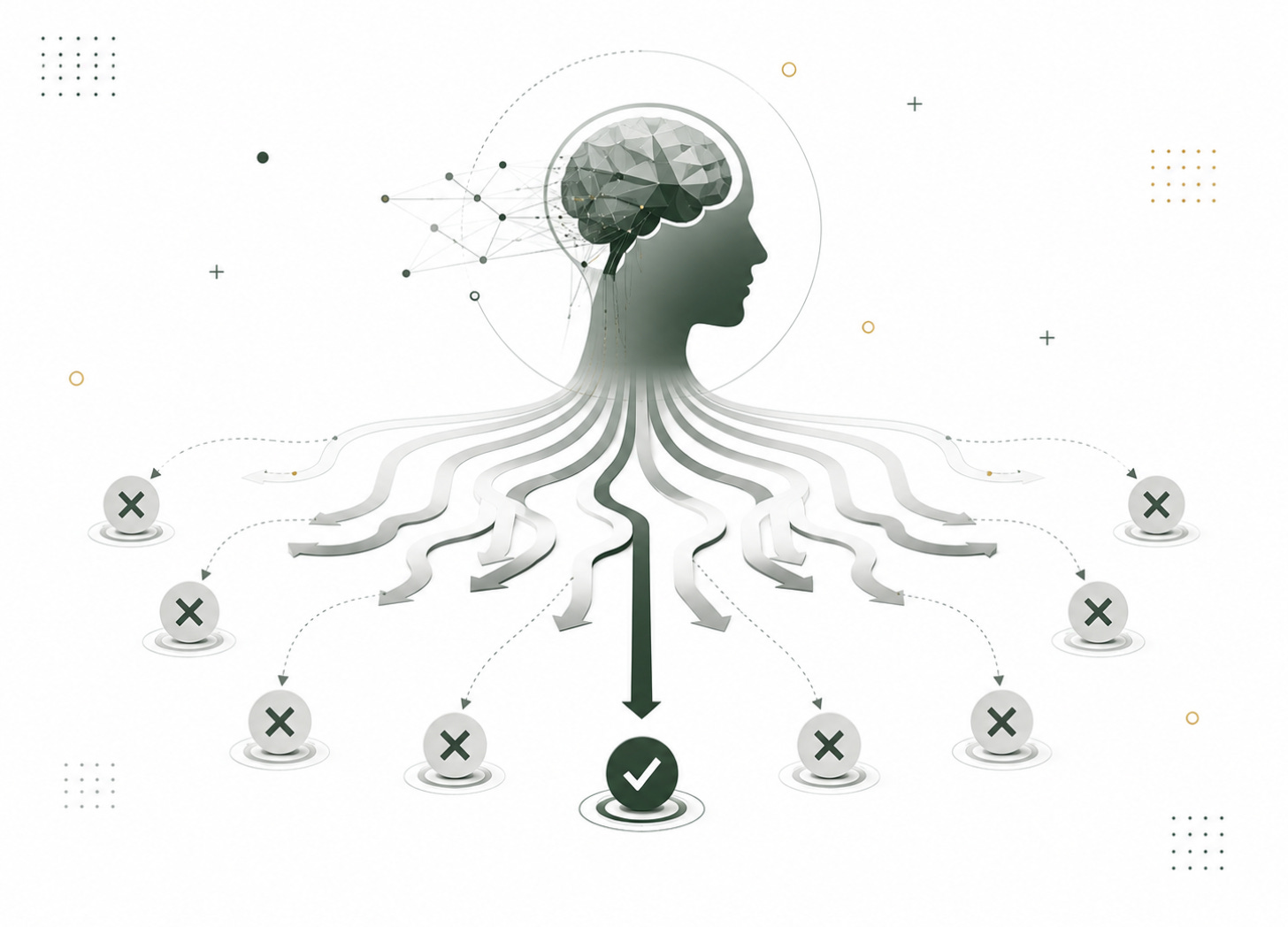
There is a specific kind of discomfort that comes after a big decision.
You made the call. You felt confident. And then, somewhere between the decision and the outcome, you realize the confidence was manufactured. Your brain gave you certainty because uncertainty felt unbearable, not because the evidence was actually there.
That experience is not a sign of poor judgment. It is a sign that you are human and that your brain is doing exactly what it was built to do.
In the 1970s, psychologists Daniel Kahneman and Amos Tversky published research that should have permanently changed how we think about human judgment.
Their work on decision-making under uncertainty demonstrated something genuinely uncomfortable: the mind does not reason toward the best answer. It reasons toward the fastest answer, and then constructs a story to make that answer feel inevitable.
They called these reasoning patterns heuristics, mental shortcuts that allow the brain to function under conditions of limited time and incomplete information. And the problem is not that we use them.
The problem is that we use them without knowing it, and we use them most aggressively in the moments that matter most.
The brain is not irrational. It is economical. And economy at scale produces systematic error.
Once you see these patterns clearly, you start recognizing them everywhere: in hiring decisions, in strategy reviews, in budget conversations, in the stories you tell yourself after something goes wrong.
The Shortcut That Makes You Judge Every Book By Its Cover
The first heuristic is representativeness, and it works like this:
When you encounter something unfamiliar, your brain immediately searches for a pattern it already recognizes and treats the resemblance as evidence.
The result is that you ignore base rates, the actual statistical reality of how often something occurs, in favor of surface-level recognition.
Kahneman used a simple example repeatedly. You hear about a man who is quiet, precise, and organized. Your brain instantly classifies him as a librarian rather than a farmer, even though there are vastly more farmers in the world. The specific detail feels informative. The statistical reality is boring. So the statistics lose.
In professional life, this plays out in ways that are harder to catch. Someone looks like a high performer based on one impressive quarter, one strong presentation, one successful project. The base rate of how people actually sustain performance over time gets ignored. And then we call it a surprise when the pattern breaks.
This shortcut produces several specific errors worth naming:
Base Rate Neglect: You ignore the actual probability of something because a vivid detail grabbed your attention first.
Conjunction Fallacy: You believe two specific conditions happening together are more likely than one general condition alone, which is mathematically impossible.
Insensitivity to Sample Size: You treat a handful of examples as if they represent the whole picture.
Regression Neglect: Extreme performances almost always move back toward average over time. You panic over a temporary slump that was always going to correct itself.
Why Your Memory Behaves Like a Dramatic Hollywood Director
The second shortcut is availability, and the rule is simple: if you can remember something easily, your brain assumes it must be common.
Your mind keeps the loudest, most emotionally charged memories right at the front of the filing cabinet, ready to retrieve in an instant. That is why flying feels terrifying and driving feels routine, even though the data says the exact opposite. You can vividly picture a plane crash. A car accident is just something that happens somewhere, quietly, to someone else.
We do not judge risk by reading spreadsheets. We judge it by how easily we can run a mental movie in our heads.
This plays out in professional settings more than most people realize. A dramatic project failure gets remembered and over-indexed. Slow cultural erosion in a team does not produce the same kind of vivid mental image, so it gets undermanaged. Organizations sometimes make major risk decisions based on the most recent bad quarter rather than a three-year pattern, because the recent event is simply easier to access.
The specific errors this heuristic produces:
Availability Bias: You think frequent events are simply the ones easiest to remember, but you usually remember them because they were loud or emotional, not because they were actually common.
Imaginability Bias: If you can easily picture a scenario, you believe it is far more likely than the data would suggest.
Illusory Correlation: You invent a connection between two unrelated events simply because they happened together in a memorable moment.
This is exactly why people lose sleep over rare dramatic risks and ignore high-probability gradual ones. One is a vivid story. The other is just a number on a report.
How a Random Number Takes Control of Your Wallet
The third shortcut is anchoring, and it is the reason negotiations, pricing strategies, and budget conversations are so easy to manipulate.
When you have to estimate something you do not fully understand, your brain grabs onto the first number it encounters. That number becomes the anchor, and even when you consciously know it is arbitrary, it acts like a magnet pulling every judgment that follows.
Here is a scenario that most people in professional life will recognize. You are reviewing a vendor proposal. The first number on the page is high, higher than you expected. You push back hard, negotiate, and land somewhere that feels like a win. You close the deal feeling like you did your job.
But the negotiation started from their number, not yours. And the final price was anchored to a figure they chose, not one that reflected actual value.
Two things are happening:
Anchoring Bias: Your final estimate is heavily influenced by the first number you encountered, even when you consciously tried to adjust away from it.
Insufficient Adjustment: Even when you recognize the anchor and try to move, you almost never move far enough.
The fix is not more willpower. It is a procedural habit: before you hear their number, commit to your own estimate first. Write it down if you have to. Give your thinking a reference point that belongs to you.
The Biases That Compound Over a Career
Beyond those three shortcuts, two patterns deserve particular attention for the damage they accumulate over time.
Overconfidence bias is the tendency to treat your own judgment as more reliable than the evidence actually supports. This is not arrogance in the common sense. It is a structural response to uncertainty. The brain experiences not-knowing as threat, so it manufactures confidence to fill the gap. What feels like decisive leadership is often well-constructed improvisation.
Kahneman’s research showed that experts in high-stakes fields, doctors, lawyers, financial analysts, are systematically overconfident about their predictions. Not because they are incompetent. Because overconfidence is a feature of how human cognition handles uncertainty, not an exception.
Hindsight bias is what happens after an outcome becomes clear. Memory quietly rewrites the past to make it feel like you saw it coming. “I knew it all along” is not insight. It is memory editing itself, backward, in real time.
The cost of this one is subtle but serious. It prevents honest post-mortems because the past always looks more predictable than it was. If you already “knew” the project was going to fail, you have no reason to examine the specific decision that made it inevitable. And so the lesson never lands.
A few more worth naming, even briefly:
Law of Small Numbers: A deep, almost irrational belief that a tiny sample of data accurately represents the whole population.
Gambler’s Fallacy: The feeling that if something random has happened repeatedly, it is somehow less likely to happen again soon.
Together, these patterns make the world feel more organized and predictable than it is. That fake certainty might reduce anxiety. But it produces serious errors in the decisions that actually carry weight.
What You Can Actually Do With This
You cannot turn these biases off. They are not habits you developed. They are architecture your brain inherited from thousands of years of evolution optimizing for speed under pressure.
What you can do is build deliberate friction into your decision process, small pauses that force the shift from fast intuitive thinking to slower, more effortful analysis, in the moments before it matters.
Here is what that looks like in practice:
Anchor yourself first. Before entering any negotiation or estimate, write down your own number before you hear anyone else’s. Give your thinking a starting point that belongs to you.
Look for disconfirming evidence. Instead of trying to prove you are right, spend a few minutes actively looking for reasons you might be wrong. This is harder than it sounds and more useful than almost anything else.
Check the base rate. Before assuming a specific outcome is likely, ask how often it actually happens across the full population. Not in your memory. In reality.
Think in ranges. Commit to a realistic range of possibilities rather than a single point prediction. It is more accurate and it builds intellectual humility into the structure of your thinking.
Wait for more data. Never trust a trend built on one or two examples. The pattern might be real. It might also be availability bias wearing a suit.
Understanding these biases will not make you a perfect decision-maker. Nothing will.
But it will make you considerably harder to fool, including by yourself. And in a career where the biggest mistakes tend to feel like the most obvious calls at the time, that is not a small thing.
The question is not whether you are biased. You are. The question is whether the bias you carry is costing you more than you realize.
Project management is not about filling spreadsheets, and the difference between a PM who is “overwhelmed” and one who is “in control” often comes down to the systems they rely on.
Don’t just manage the timeline. Lead the outcome.
Take the next step in your leadership journey:
Review the Standards: Anchor your work in global best practices at Standards.
Use the Resources: Download the guides and templates on the Resources Page.
Upgrade to VIP: Get the complete execution framework via VIP Access.
For a broader perspective on navigating life and career without burnout, join the conversation at Meller Notes.