

What Is Lean: A Complete Beginner's Guide

Have you ever looked at your team’s workflow and felt that something was clogging the pipes?
Everyone is busy. Everyone is working hard. But the output is sluggish. Projects get stuck in “Review” for weeks. Decisions bounce between committees. You have to fill out a form to get permission to fill out another form.
This is not a people problem. This is a Waste problem.
In the corporate world, we often confuse “motion” with “progress.”
We think that if everyone is typing furiously, we are being productive.
But often, we are just spinning our wheels. We are producing reports no one reads, building features no one uses, and holding meetings that decide nothing.
Lean is the discipline of seeing the waste and ruthlessly eliminating it.
It is not just about cutting costs. It is about speed. It is about flow. It is about respecting human capability by not asking people to do useless work.
This is your definitive guide to the philosophy, the history, and the mechanics of Lean.
The Origin Story (From Looms to Cars)
To understand Lean, you must travel back to post-war Japan.
In 1950, Japan was devastated. Its economy was ruined. Toyota, a small car manufacturer, was on the brink of bankruptcy. They couldn’t afford the massive inventory systems of Ford or GM. They couldn’t afford to waste a single screw.
An engineer named Taiichi Ohno looked at the problem and realized something profound: The American way of “Mass Production” (building huge batches of cars and storing them in warehouses) was inefficient. It hid defects. It tied up cash.
So, Ohno invented a new system.
He called it the Toyota Production System (TPS).
Instead of building for stock, they built only what the customer ordered (Just-in-Time).
Instead of fixing errors at the end, they stopped the line the moment an error occurred ( ).
Instead of managers dictating the process, the workers optimized it themselves (Kaizen).
The result? Toyota became the most efficient and profitable manufacturer in the world. The West studied their system, stripped away the Japanese terminology, and gave it a new name: Lean.
The Core Definition
What is Lean?
Lean is the relentless pursuit of value through the elimination of waste.
It is not a cost-cutting exercise. It is a growth strategy.
Value: Anything the customer is willing to pay for.
Waste (Muda): Anything that consumes resources but adds no value to the customer.
If you are writing code, that is value. If you are waiting for the server to deploy, that is a waste.
If you are treating a patient, that is Value. If you are walking to the other side of the hospital to get a bandage, that is Waste.
The Five Principles of Lean
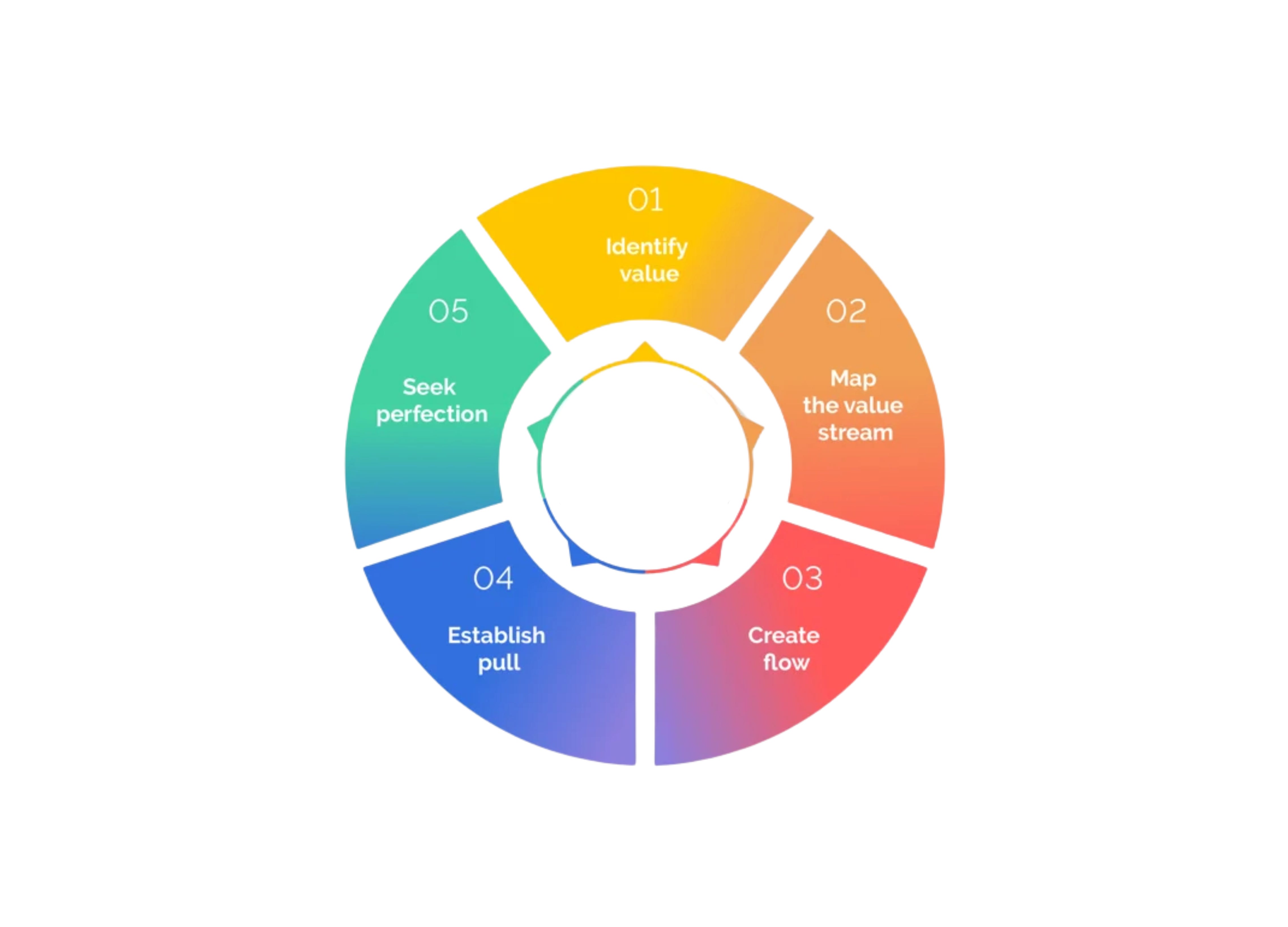
James Womack and Daniel Jones, who codified Lean for the West, established five principles. These are the laws of physics for a Lean organization.
1. Identify/Define Value
You must define value from the customer’s perspective. The customer doesn’t care about your internal processes, your org chart, or your hard work. They care about their problem being solved. Anything else is noise.
2. Map the Value Stream
Once you know the Value, you map the steps required to deliver it. This is called Value Stream Mapping. You draw the process from “Order Received” to “Product Delivered.” Then, you look at the map. You will be shocked. Usually, value is only being added 5% of the time. The other 95% is waiting, transport, or rework.
3. Create Flow
Now, you remove the barriers. You want the product to “flow” through the system like water. You remove the approval committees. You automate the hand-offs. You stop the batching.
4. Establish Pull
In a traditional system (Push), we build things and hope someone buys them. In a Lean system (Pull), we don’t build anything until the customer asks for it. This eliminates the waste of overproduction.
5. Seek Perfection (Kaizen)
This is the spiritual core of Lean. You are never done. You are constantly looking for the next 1% improvement. It is a culture of dissatisfaction with the status quo.
The Seven Wastes (Muda)
To eliminate waste, you must be able to see it. Taiichi Ohno categorized waste into seven types. As a manager, you should memorize these.
Transport: Moving things (or data) unnecessarily. Example: Sending a file via email to three different people for approval.
Inventory: Storing work that isn’t finished. Example: A backlog of 500 unread tickets.
Motion: People moving more than necessary. Example: Clicking through 10 screens to find one piece of information.
Waiting: People waiting for the next step. Example: Waiting for a code review.
Overproduction: Creating more than is needed. Example: Writing a 50-page report when a 1-page summary was needed.
Over-processing: Doing more work than the customer values. Example: “Gold-plating” a feature that the user rarely touches.
Defects: Mistakes that require rework. Example: A bug found in production.
(Modern Lean adds an 8th Waste: Unused Talent—failing to use the creativity of your people).
The Mechanics (The Toolset)
Lean is a philosophy, but it runs on tools. Here are the engines of execution.
Kanban (Visual Flow)
Kanban is the dashboard of Lean. You visualize the work on a board. You see where the pile-ups are. You limit “Work In Progress” (WIP) to ensure flow.
The “Andon Cord” (Stop the Line)
At Toyota, every worker has a cord they can pull to stop the entire assembly line if they see a defect.
In knowledge work, this means any team member can say, “Stop. The requirements are unclear. We cannot proceed until we fix this.” It feels expensive to stop the line, but it is much cheaper than fixing the mistake later.
The 5 Whys (Root Cause Analysis)
When a problem happens, we don’t ask “Who did it?” We ask “Why did it happen?” five times.
The server crashed. Why?
Because the memory filled up. Why?
Because the code had a leak. Why?
Because the engineer didn’t test it. Why?
Because the deadline was unrealistic. (Aha. That is the root cause).
Lean and Agile (The Cousins)
People often confuse Lean and Agile. They are cousins, but they have different personalities.
Lean is obsessed with Efficiency and Flow. It hates waste. It wants to go from A to B with zero friction.
Agile is obsessed with Adaptability and Learning. It hates rigidity. It wants to change direction quickly.
In the modern world, the best organizations use both. They use Agile to figure out what to build (Iterative Learning), and they use Lean to figure out how to build it fast (Flow Efficiency).
There is a misconception that Lean is mean. People hear “efficiency” and think it means firing people or making them work harder.
This is false. The second pillar of the Toyota Way (after Continuous Improvement) is Respect for People.
Lean respects people by refusing to waste their time. It respects people by empowering them to fix their own processes.
It respects people by acknowledging that the person doing the job knows more about it than the manager does.
If you implement Lean correctly, your team won’t feel squeezed. They will feel liberated. They will spend their day creating value, not fighting bureaucracy.
Stop managing the people. Start managing the flow.