

Issue Escalation and Ownership Model: Define How to escalate without creating noise
The escalation model that separates professional project leaders from reactive firefighters

📣 Before we start, you might think these notes are just tips, but they are parts of a complete delivery system. If you find value here, you are likely missing out on the specialized layers designed to help you navigate complexity:
The Standards: Understand the frameworks that govern high-impact delivery at Standards & Frameworks.
The Toolkit: Access the Free Resources to audit and upgrade your project documentation.
The Accelerator: For those ready to move from coordination to strategy, the VIP Premium Packs provide the systems to scale your impact.
Ah… And if your focus is not only on your projects, but also learn the internal systems of your career and personal growth, you should check Meller Notes.
This article is part of a Project Management Compass Premium Pack:

Let me ask you something uncomfortable before we start.
Think about the last project that went sideways. Not the moment the crisis became visible in the status report.
The moment before that. The quiet weeks when someone on the team knew something was wrong, felt the drag, noticed the signal, and said nothing.
How many days passed between “we sensed this” and “we finally said something out loud”?
That gap. That silence. That is where most projects actually die.
And here is the uncomfortable part: it is almost never caused by incompetent people. It is caused by the absence of a clear model that tells people exactly when to act alone, when to pull someone else in, and how to do it without creating organizational noise, political friction, or the dreaded reputation of being “the person who panics.”
This article is the full playbook. Not surface-level theory.
We are building something you can actually use, with definitions, structure, behavioral science, practical templates, and PMBOK 8 references that anchor it in the discipline.
Grab a coffee. This one is long for a reason.
Today we will cover:
Part 1: Getting the Language Right — Why risk, issue, and decision are three completely different words that require three completely different responses, and what happens when teams confuse them.
Part 2: Why Escalation Fails — The behavioral science behind delayed bad news, the bystander effect inside project teams, and the noise aversion trap that sits on the other end.
Part 3: The Three-Zone Classification Model — A structured routing system that tells anyone on the team exactly what to do with a problem the moment it surfaces, without relying on gut feeling or political radar.
Part 4: The Ownership Contract — Why shared ownership is the same as no ownership, how to assign accountability correctly, and the authority trap that kills resolution before it starts.
Part 5: The Trigger System — Four categories of mechanical, pre-agreed escalation triggers that move issues between zones based on objective criteria, not emotional state.
Part 6: The Issue Log as a Living System — The twelve-field structure your log needs, why each field exists, and the four-question review loop that keeps it alive between meetings.
Part 7: Escalation Communication Templates — Two copy-paste templates for Zone 2 and Zone 3 escalations, plus the exact language that should never appear in any escalation communication.
Part 8: Escalation Without Politics — Three principles that neutralize the political risk of raising a flag early and transform escalation from a personal judgment into a professional act.
The Escalation and Ownership Compass — A seven-step reference checklist you can keep open during any active project.
Part 1: Getting the Language Right
Before any model works, the team needs to speak the same language. In most project environments, the language around problems is a mess. People use “risk,” “issue,” and “decision” as if they mean the same thing. They do not.
Using the wrong word for the wrong situation sends the wrong people to the wrong meetings with the wrong expectations and produces zero action. Let us define all three clearly.
Risk is defined in PMBOK 8 as
“An uncertain event or condition that, if it occurs, has a positive or negative effect on one or more project objectives.”
The keyword is uncertain. A risk has not happened yet. It lives in the future.
You monitor it, plan responses for it, and try to shift its probability or impact before it becomes real.
Issue is defined in PMBOK 8 as
“A current condition or situation that may have an impact on the project objectives.”
The key word is current. An issue has already happened. The uncertainty is gone. What remains is the need for resolution. Issues require action, not prevention.
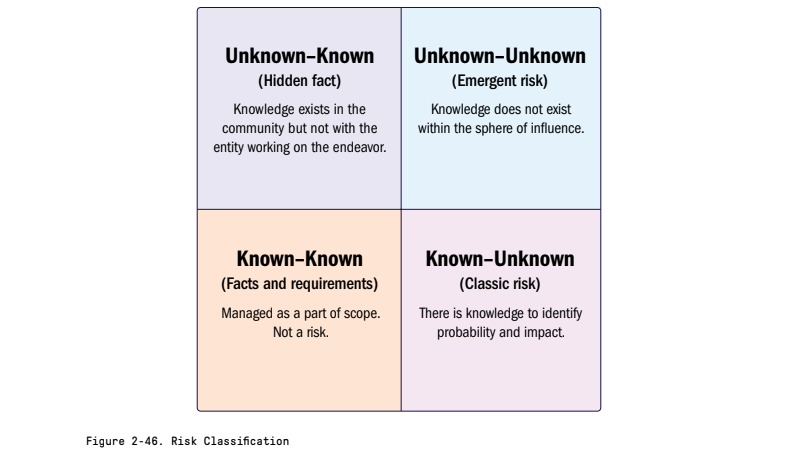
Decision Request is a request for authority. When an issue or risk creates a fork in the road and the project team does not have the power to choose the path alone, a decision is needed from someone with the right authority level.
Decisions are not escalations of panic. They are structured requests.
Why does this matter so practically?
Because when you show up to a meeting with an “issue” that is actually a risk, your sponsor prepares to decide, and instead hears a hypothetical.
When you escalate a “risk” that has already become a real problem, you lose credibility because you are late.
When you ask for a “decision” without framing it as one, the executive hears a complaint and responds with empathy instead of authority.
The rule for your team: Every item raised in any project communication must be labeled as one of three things: a risk (something that might happen), an issue (something that has happened), or a decision request (authority needed to move forward). This label determines who responds, how fast, and in what format.
Make this a team norm. It takes three weeks to stick, and it changes the quality of every meeting afterward.
Part 2: Why Escalation Fails
The PMBOK 8 dedicates significant attention to the human side of project management, emphasizing that project performance is deeply shaped by human behavior, communication patterns, and team psychology.
But let us be honest about what actually happens inside real teams.
The Delay Bias
There is a well-documented psychological pattern called self-serving attribution bias. When things go wrong, people instinctively search for ways to fix the problem before reporting it, in order to protect their perceived competence. A team member who discovers a critical integration failure will often spend two or three days trying to solve it quietly before raising the flag.
In a project where the buffer is measured in days, that silent repair attempt can consume irreplaceable time. This is not laziness or malice. It is a predictable human response to an environment where bad news feels dangerous.
The Bystander Effect in Team Ownership
Psychologists Bibb Latané and John Darley first documented diffusion of responsibility in 1968.
Their core finding: when a problem is visible to multiple people simultaneously, each person assumes another will act. The more people who witness it, the less likely any individual is to take personal ownership.
In projects, this manifests as the “team issue.” When an item is assigned to “the dev team” or “the architecture group,” it is effectively assigned to nobody. It will not move until someone panics or an executive notices.
The Noise Aversion Problem
On the other hand, some people escalate everything instantly to the highest available authority. This trains your sponsor to treat your alerts as background noise. When a genuine crisis arrives, their urgent response is already depleted from previous overreactions.
A functional escalation model must solve both problems simultaneously. It must make early escalation feel safe and expected, while also creating friction against unnecessary escalation to senior stakeholders.
The three-zone model does exactly this.
Part 3: The Three-Zone Classification Model
Think about how an air traffic control system works. Every aircraft in the sky is classified by type, altitude, speed, and urgency.
Tiny private planes and massive commercial jets share the same airspace, but they do not all talk to the same controller at the same frequency.
There is a structured routing system that ensures each signal reaches the right person at the right level.
Your project needs the same infrastructure. But we will learn this today.
