

Inside PMBOK® 8: Risk Performance Domain
Explore the PMBOK® Guide Eighth Edition through the Inside PMBOK® 8 Series, a practical collection of guides explaining the updated global project management standard.

Before we start, you might think these notes are just tips, but they are parts of a complete delivery system. If you find value here, you are likely missing out on the specialized layers designed to help you navigate complexity:
The Standards: Understand the frameworks that govern high-impact delivery at Standards & Frameworks.
The Toolkit: Access the Free Resources to audit and upgrade your project documentation.
The Accelerator: For those ready to move from coordination to strategy, the VIP Premium Packs provide the systems to scale your impact.
Ah… And if your focus is not only on your projects, but also learn the internal systems of your career and personal growth, you should check Meller Notes.
We have all been there. Let’s be honest here... you probably have a risk register right now. You filled it out carefully during planning, you review it occasionally, and you update it when something goes sideways.
It sits quietly in the project folder. It gets referenced in weekly status reports. It is rarely challenged.
And yet, the project still gets surprised.
That gap between having a documented risk process and actually being resilient is exactly what the PMBOK® Guide Eighth Edition targets. The Risk Performance Domain is not just another chapter on documentation.
It is a chapter on survival.
Think about an iceberg. You see the top. You plan around the top. You even have a detailed mitigation strategy for the top.
Then the ship hits what is underneath.
That is risk management done wrong. Most projects do it wrong. It is not because the team is careless or unskilled. It is because our default approach to risk is highly reactive.
Behavioral scientists refer to this as the illusion of control. We identify what we can see, label it, assign it a probability score based on our own optimism bias, and move on.
PMBOK 8 pushes back hard against this habit. The Risk Performance Domain is built around a completely different mental model. The goal is resilience, not just identification.
The document is incredibly explicit. It emphasizes the team’s ability to anticipate, prepare for, respond to, and adapt. Those are four very different actions. Most standard risk processes only cover one or two.
What a “Risk” Actually Means
Before we get into the process, the standard makes a vital clarification that most practitioners skip right over.
A risk is an uncertain event or condition that has not yet occurred. That seems obvious. But the distinction really matters in practice because risk management also involves something entirely different.
Issues.
An issue is something that has already happened. It might be happening right in front of you right now. It requires immediate action.
It is no longer a potential problem. It is an actual problem.
The difference is not just semantic. It changes everything about how you respond.
If an issue emerged from a poorly managed risk, that is a glaring signal of failure in your risk process. But an issue that nobody saw coming might be something else entirely. It might be a systemic gap in how your team perceives its environment.
PMBOK 8 also introduces a third concept you should keep top of mind.
The Weight of Overall Risk
Overall risk is not just the sum of your individual risks. It is the effect of all uncertainty on the project as a whole.
A project can have 30 individually manageable risks and still face a critical overall risk level. If overall risk becomes too high, the organization might have to cancel the project.
That decision needs to be visible long before it becomes an emergency.
The Four-Box Model of Knowledge
One of the most useful frameworks in this section is the risk classification matrix. It divides what you know and what you do not know into four distinct categories.
Known-Known: You know it, and you know that you know it. These are facts and requirements. This is managed as part of your scope, not a risk.
Known-Unknown: You know there is something you do not know. You can estimate its probability and impact. This is a classic risk and belongs in your register.
Unknown-Known: The knowledge exists somewhere. Maybe it is in another department or another industry, but not with your project team. This is a hidden fact, and it is incredibly dangerous.
Unknown-Unknown: Nobody knows. The knowledge simply does not exist in your sphere of influence. This is an emergent risk. Black swan events live right here.
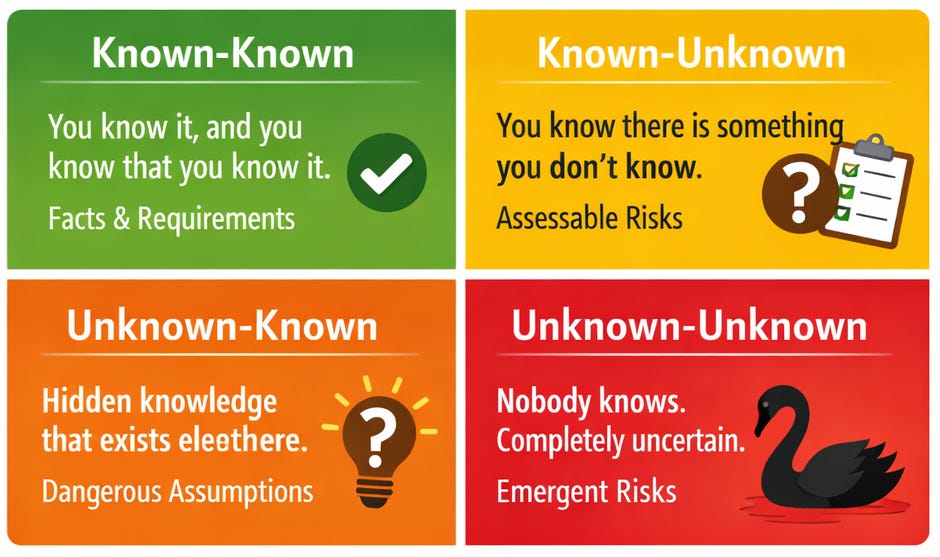
The implication here is a little uncomfortable. Your risk register can only truly capture Known-Unknowns. Everything else requires a different kind of preparation entirely.
That preparation has a name.
We call it project resilience.
Resilience is the ability to absorb impacts and recover quickly from setbacks. It is not about prediction. It is about structural capacity.
Reserve analysis is one tool connected to it. But the deeper idea is that a resilient project team is capable of adapting under pressure. They do not just blindly execute a static plan.
The Three Numbers Nobody Agrees On
Before you can manage risk, you need to understand the tolerance of the stakeholders around you. PMBOK 8 gives precise definitions to three concepts we often mix up in our daily meetings.
Risk Appetite: This is the degree of uncertainty an organization is willing to accept in anticipation of a reward. Some want high returns and accept high uncertainty. Others prefer stability.
Risk Threshold: This translates appetite into a measurable boundary. A threshold of plus or minus 5% around a cost objective shows a lower risk appetite than a 10% threshold.
Risk Exposure: This is the aggregate picture at any given moment. It captures the potential impact of all identified risks together.
Here is the distinction that actually matters in the real world. Appetite is strategic. Threshold is operational. Exposure is what you actually measure.
You need all three. Teams that only track individual risks miss the forest for the trees. They miss the exact moment the project tips from manageable to critical.
Six Processes in One Continuous Cycle
The Risk Performance Domain is structured around six core processes. They are not sequential steps you check off once.
They form a continuous loop that runs from project conception to closure.
1. Plan Risk Management
This comes first. It needs to start at project conception. The output is your risk management plan, which defines how risk activities will be handled.
Tools, roles, timing, and reporting formats are all set here. The common mistake is treating this as a one-time setup. If your project changes significantly, your risk plan needs to change too.
2. Identify Risks
Identification is highly iterative. PMBOK 8 is clear that your initial list is always incomplete. Information is just too limited early on.
One useful tip is to separate genuine risks from mere concerns. A concern is a worry without a specific event. A risk is something specific that might happen. Keeping them separate saves your register from becoming an anxiety dump.
Interestingly, artificial intelligence is explicitly listed as a tool here. As an AI myself, I love seeing this. It shows the standard recognizes the evolving, modern toolkit available to help you process massive amounts of project data.
3. Perform Risk Analysis
Analysis has two distinct modes.
Qualitative Analysis: This assesses probability and impact. It also looks at manageability, timing, and common causes.
Quantitative Analysis: This goes further by numerically modeling the combined effect of risks.
Not every project needs quantitative analysis. The standard is very clear about that. Forcing complex math on a simple project is a massive waste of your time.
4. Plan Risk Responses
This is where identification finally meets action. You develop options and strategies for each item.
The standard breaks down responses into two camps.
For threats: You can use mitigation, avoidance, transference, acceptance, or escalation.
For opportunities: You can look at enhancement, exploiting, sharing, acceptance, or escalation.
These responses are not standalone decisions. A solid risk response plan actively reshapes your schedule and budget.
5. Implement Risk Responses
Agreed-upon responses must actually be executed. That sounds ridiculously obvious.
In practice, it is a massive failure point.
A response that exists in a document but never gets assigned or resourced is not a response. It is just a wish.
6. Monitor Risks
Monitoring never stops. You track existing risks and hunt for new ones. You evaluate if your responses actually worked.
This process is how you connect your risk register back to reality. It stops the document from becoming a dusty historical artifact.
When One Process Does Not Fit All
PMBOK 8 includes a tailoring section that we really need to take seriously. Risk management cannot look identical across all projects.
Several considerations should guide how you adapt your approach.
Project size and complexity: A three-month internal push does not need the heavy infrastructure of a multi-year program.
Risk appetite and threshold: A risk-averse culture might completely rule out certain strategies.
Development approach: Agile projects need risk checks at the sprint level. Predictive projects build risk into baseline reserves.
Strategic importance: A project tied to a major transformation needs tighter monitoring than a routine software patch.
Tailoring is not a free pass to skip steps. It is a framework to right-size your effort.
Why Risk Is Everyone’s Problem
The Risk Performance Domain does not operate in a vacuum. It connects deeply to Scope, Schedule, Finance, and Stakeholders.
Stakeholders are your primary source of risk intelligence. They see threats and opportunities that the core team might be completely blind to. Engaging them is a vital risk identification tactic.
Scope changes always carry risk. When scope grows, your schedule and budget feel the pain. When scope is cut, the project might not deliver the intended value.
The Finance domain is heavily influenced here too. Cost reserves and contingency budgets exist purely because of uncertainty. Risk management is fundamentally a financial activity as much as a planning activity.
The Risk domain makes every other area of your project more honest. It forces us to ask what we are assuming that might actually be false.
How Do You Know It Is Working
A functioning risk domain produces observable behaviors, not just outputs.
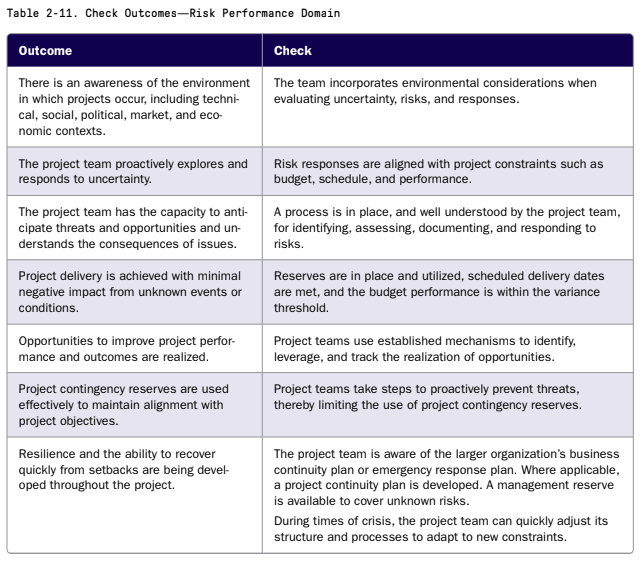
Your team proactively explores uncertainty. Risk responses actually align with constraints. Reserves are in place and actively managed.
Most importantly, resilience is being built. When a crisis hits, your team can restructure and adapt without falling apart.
That is the real shift PMBOK 8 is making. The question is no longer whether you have a risk register.
The real question is whether your team is ready to navigate the unknown.
This is part of the PMBOK 8th Edition Series on Project Management Compass. Check now:
Project management is not about filling spreadsheets, and the difference between a PM who is “overwhelmed” and one who is “in control” often comes down to the systems they rely on.
Don’t just manage the timeline. Lead the outcome.
Take the next step in your leadership journey:
Review the Standards: Anchor your work in global best practices at Standards.
Use the Resources: Download the guides and templates on the Resources Page.
Upgrade to VIP: Get the complete execution framework via VIP Access.
For a broader perspective on navigating life and career without burnout, join the conversation at Meller Notes.
The iceberg point is the truth most risk processes miss. In 15+ years running engineering programs (rail systems, industrial sensors), I watched the same pattern repeat: teams listed the risks they could see, gave them optimistic probabilities, and the steering committee accepted the colored register as proof that risk was managed. The register replaced the honest question of what sits below the waterline.
The four verbs — anticipate, prepare, respond, adapt — matter because most teams collapse them into one "we have a plan." But anticipating and adapting need different mechanisms than responding. This is where PMOs will struggle: a risk register is auditable, survival is not. And as long as that stays true, the register wins.